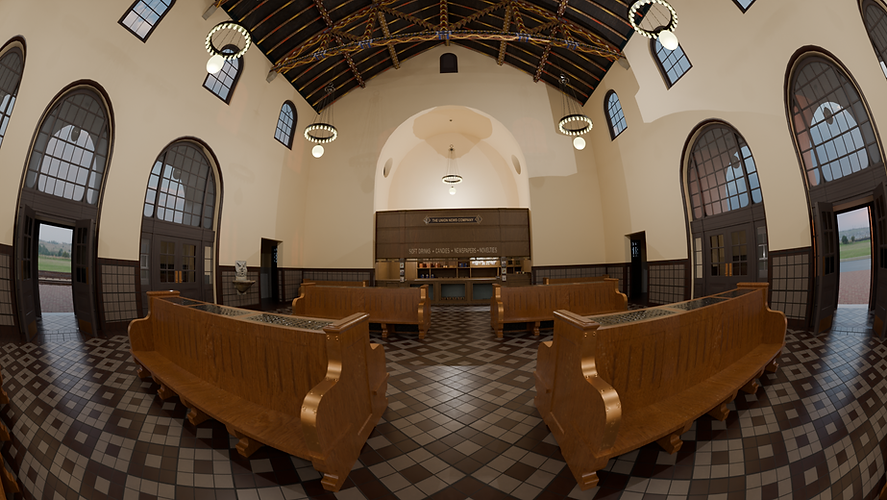
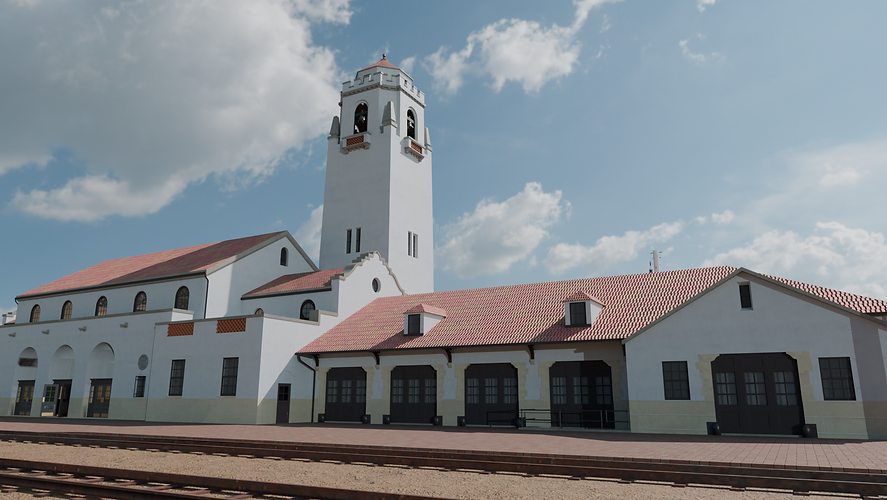
Boise Train Depot Digital Twin
Role: Team Lead / Primary Building Modeler
Focus: Digital Twin Development, Historical Reconstruction, 3D Modeling, Reference-Based Asset Creation, Real-Time Visualization
The Boise Train Depot Digital Twin project focused on recreating a historically accurate 3D representation of the Boise Train Depot, with an emphasis on the building’s 1920s-era appearance. Working from original architectural blueprints, historic photographs, archival references, and feedback from history and design faculty, our team translated real-world documentation into a detailed digital environment suitable for visualization, education, and an optimized real-time 3D tour.
As the GIMM team lead and primary building modeler, I helped guide a five-person team that modeled different aspects of the Train Depot, including the Platt Gardens, the train, and other historical artifacts. The project required careful attention to scale, historical accuracy, material interpretation, and clean asset organization so the final environment could function as both a visual reconstruction and a usable real-time digital twin.
My work included modeling architectural components, interpreting incomplete historical references, coordinating asset standards across the team, reviewing models for consistency, and preparing assets for real-time use. This involved balancing visual detail with performance, ensuring that models were accurate enough for historical interpretation while remaining optimized for interactive visualization workflows. Additionally, I led the photogrammetry/photo-scanning process for various 1920s artifacts that are currently on display in the Boise Train Depot.
The project strengthened my experience in digital twin production, BIM-adjacent modeling, scan/reference-based reconstruction, interdisciplinary collaboration, and real-time 3D asset pipelines.